

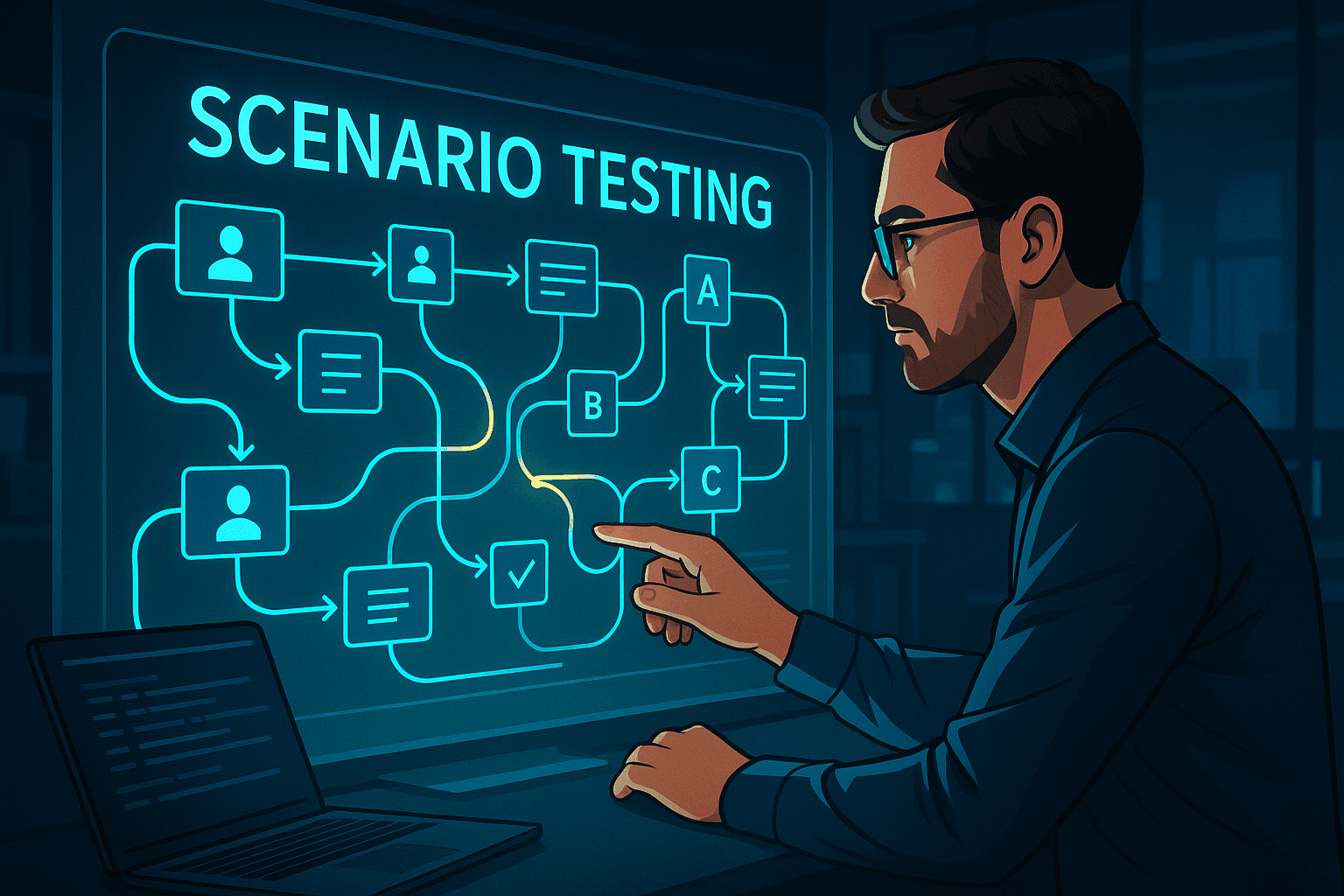
In the world of software development, ensuring that applications work as expected under real-world conditions is critical. This is where software testing scenarios play a vital role. Scenarios help QA teams validate that a system behaves correctly from an end-to-end perspective, not just in isolated units.
At its core, scenario testing focuses on replicating real user journeys or workflows to uncover issues that might not be detected in traditional test cases. It combines functionality checks with usability, integration, and even performance considerations to provide a holistic view of software quality. For an in-depth explanation of this approach, see software testing scenarios.
What Are Software Testing Scenarios?
Software testing scenarios are detailed narratives that describe how an end user might interact with a system to complete a specific task. Instead of focusing on individual functions, scenarios capture a sequence of steps representing realistic use cases such as signing in, making a purchase, or updating user information.
Unlike scripted test cases that validate discreet application behaviors, scenario tests simulate entire workflows. This helps identify defects that only surface when multiple components interact.
Why Scenario Testing Matters
Scenario testing serves several important functions in modern QA processes:
- Realistic Validation
Scenario tests mirror actual user behavior, exposing issues that unit or functional tests may miss. - End-to-End Coverage
By examining complete workflows, scenario testing ensures that integrations between modules are functioning as expected. - Enhanced User Experience
Tests based on real use cases help teams focus on what matters most — delivering smooth and intuitive user interactions. - Better Risk Assessment
They help prioritize testing based on usage patterns and critical business processes.
Common Software Testing Scenarios
Here are some examples of real-world scenarios every QA team should consider:
🛒 E-Commerce Checkout Flow
Test the process of searching for a product, adding it to a cart, applying discounts, and completing payment.
👤 User Authentication
Validate scenarios for successful login, password reset, multi-factor authentication, and failed login attempts.
💳 Payment Gateway Integration
Simulate successful and failed payment transactions through third-party providers.
📣 Notification Workflows
Test email or SMS notifications triggered after specific user actions, such as order confirmation.
📦 Inventory Updates
Verify how inventory levels change when orders are placed, canceled, or returned.
Best Practices for Scenario Testing
To get the most out of your scenario tests, follow these best practices:
- Use Realistic Data
Populate tests with representative test data that reflects actual user inputs. - Prioritize Key Workflows
Focus on scenarios that impact core business functions and high-traffic user interactions. - Automate Where Possible
Automate repetitive scenarios to increase efficiency and catch regressions early. - Review Frequently
Keep your scenarios up to date as features evolve. - Integrate With CI/CD
Trigger scenario tests as part of your build pipeline to maintain continuous quality.
Scenario Testing vs. Other Testing Types
Scenario testing complements other testing approaches:
| Testing Type | Focus | Best For |
| Unit Testing | Individual functions | Catching low-level bugs |
| Functional Testing | Feature behavior | Validating specific requirements |
| Scenario Testing | Complete workflows | Real-world user experience |
| Performance Testing | System under load | Speed and scalability |
This layered strategy ensures that applications are reliable, performant, and user-friendly.
Conclusion
Software testing scenarios are essential for validating how real users interact with applications under typical and edge-case conditions. By focusing on complete workflows rather than isolated functions, QA teams can identify deeper issues, improve user satisfaction, and deliver higher-quality software.
For more on how scenario testing works, and why it’s a crucial part of QA strategies, explore this detailed guide on software testing scenarios.
Hi, I ddo beliieve thnis iss an excedllent blog.
I stuumbledupon iit 😉 I may return yyet again simce i have bpok markked it.
Monedy andd frdedom iis the greaatest wayy tto change, mmay yoou bee rich aand
cobtinue to hedlp others.
my wsbpage :: txxxvideos
The distinction between isolated test cases and scenarios that follow complete user workflows is especially useful, since integration defects often appear only across multiple steps. The checkout example also shows why realistic data and failed-payment paths should be included alongside the expected route. For teams validating design workflows, Font Detector could support a scenario where users identify typefaces from uploaded screenshots or logos.
References:
Play casino with wire transfer australia wire transfer pokies app australia